

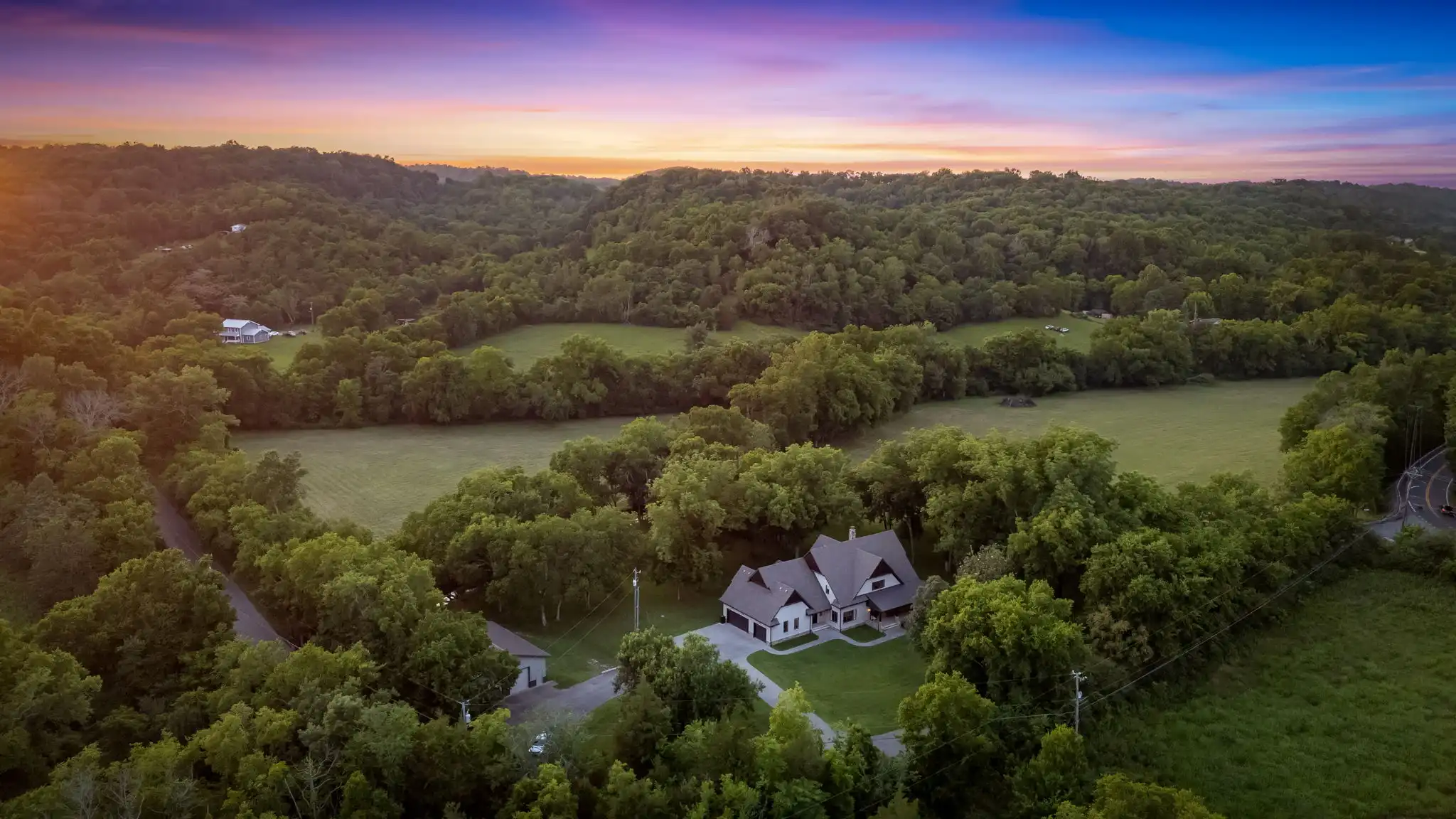
The Land Edit
For buyers dreaming about land in Middle Tennessee, the search often begins with a number.
Five acres. Maybe ten. Or perhaps enough land that the house disappears from the road altogether.
But around Franklin and Williamson County, acreage doesn’t work quite that simply. Five acres in Leiper’s Fork can offer an entirely different lifestyle from five acres in Arrington. Ten acres in College Grove may open possibilities that are increasingly difficult to find closer to Downtown Franklin. And once the search stretches south toward Thompson’s Station, Spring Hill, and Maury County, buyers may discover larger tracts, but they’re also making different decisions about location, infrastructure, commute, and long-term growth.
So the better question isn’t necessarily:
Where can I get the most land?
It’s:
Where can I find the right land for the life I actually want to live?
If You Want Acreage and Still Want to Feel Close to Franklin
Start with the edges of Franklin itself. There are still pockets surrounding Franklin where large-lot homesteads, farms, estate properties, and undeveloped land exist surprisingly close to town. The western and southwestern sides are particularly interesting. Think Carters Creek Pike, Southall Road, Old Hillsboro Road, Leipers Creek Road, and the countryside extending toward Leiper’s Fork.
This is where buyers can find that combination of acreage and privacy without feeling disconnected from Downtown Franklin. But there’s a reason these properties command attention. Franklin’s own long-range planning documents describe portions of its southwestern planning area as a rural gateway, characterized by large lots, significant vacant land, the West Harpeth River corridor, hillsides, and estate residential properties.
The city has also intentionally reduced portions of its Urban Growth Boundary along areas including Carters Creek Pike and Southall Road as part of efforts to help preserve rural character.
In other words, that countryside buyers fall in love with isn’t accidental. It’s part of Franklin’s identity.
What we like about this area:
You can potentially have meaningful acreage while remaining relatively close to Downtown Franklin, Westhaven, Berry Farms, Cool Springs, and I-65 depending on the exact location.
What buyers should understand:
Inventory can be scarce, and not every acre will be equally usable. This part of Williamson County can include hills, waterways, floodplain, wooded terrain, and other natural features.
If proximity to Franklin matters just as much as acreage, however, this is one of the first areas we’d watch.
If You Want the Leiper’s Fork Lifestyle
Leiper’s Fork is usually less about maximizing acreage for the dollar and more about where the acreage is located.
There’s a reason buyers specifically ask for it by name. The village and surrounding countryside have developed an identity that’s difficult to reproduce elsewhere: historic properties, rolling farmland, equestrian estates, artists, local businesses, winding roads, and an unusually strong sense of place.
Williamson County recognizes that character formally. Leiper’s Fork has its own Village Special Area Plan and zoning district, designed specifically to preserve and enhance its small-town character, traditional development pattern, open space, and natural resources. That’s an important clue for buyers. You’re not simply buying acreage west of Franklin. You’re buying into an area where preservation and character have been central to planning decisions.
Who it tends to appeal to:
Buyers who value privacy, character, equestrian possibilities, scenic surroundings, and proximity to Franklin more than simply getting the largest parcel possible.
The insider consideration:
“Leiper’s Fork” can be used loosely in real estate conversations. There’s the actual historic village, and then there’s a much broader countryside people may casually describe as the Leiper’s Fork area. If that location specifically matters to you, don’t rely on the marketing description alone. Understand exactly where the property sits.
If You Want 5 to 20+ Acres: College Grove Deserves a Serious Look
If someone tells us:
“We want land, but we still want Williamson County.”
College Grove is going to be part of the conversation. This is where the search can begin to feel different.
Instead of squeezing acreage into an increasingly suburban landscape, parts of College Grove still offer the rolling fields, working farms, equestrian properties, large estates, and undeveloped tracts that many relocation buyers picture when they imagine Middle Tennessee.
It’s also an area where five, ten, twenty, and significantly larger acre parcels can all enter the conversation depending on inventory and budget.
Williamson County has adopted a dedicated Special Area Plan and specific zoning standards for College Grove Village, reflecting both the area’s historic crossroad-community character and the growth pressure facing it. And that’s an important distinction.
College Grove is rural, but it isn’t static.
Growth around State Route 840, The Grove, Page-area development, and southeastern Williamson County means buyers should pay attention not only to what surrounds a property today, but also to what’s happening nearby.
Why College Grove stands out:
For someone envisioning horses, a barn, pasture, a hobby farm, a large garden, a workshop, or simply more distance between neighbors, College Grove can offer a compelling balance between usable countryside and Williamson County access.
There are active equestrian operations here today, which is another indication of how naturally the horse lifestyle fits into parts of the area.
The insider consideration:
College Grove is geographically broad. Two homes with a College Grove address can provide very different experiences when it comes to access to Franklin, I-840, Nolensville, Murfreesboro, and everyday amenities. Don’t shop the ZIP code. Shop the road. P.S. Our team can help with this.
If You Want Countryside but Need Convenient Access: Arrington
Arrington occupies an interesting middle ground.
It can feel unmistakably rural. Think rolling land, farms, vineyards, estate properties, while remaining surprisingly connected to Franklin, Brentwood, Nolensville, and I-840 depending on where you are. For buyers who don’t necessarily need 30 or 50 acres but want room around the house, Arrington can be particularly compelling.
It’s also an area experiencing meaningful growth pressure. Williamson County includes Arrington among the communities receiving more focused planning because these historic crossroad areas combine limited infrastructure with increasing development interest.
Who should look here:
Someone who wants land to feel like a retreat but doesn’t want everyday life to feel remote. Five acres in the right Arrington location may accomplish the lifestyle goal better than substantially more acreage farther away.
The insider consideration:
Don’t assume “Arrington” means the same landscape in every direction. Some pockets feel pastoral and secluded. Others are increasingly influenced by nearby residential growth. For an acreage buyer, what’s around the property can matter almost as much as what’s inside the property lines.
If You Want More Room to Create: Thompson’s Station
Move south of Franklin and another possibility opens up. Thompson’s Station has long attracted buyers who want countryside while remaining connected to Franklin and the broader Nashville region.
And the area’s agricultural and equestrian identity isn’t merely nostalgic. Working farms and significant equestrian facilities continue to operate around Thompson’s Station today. For someone envisioning horses, livestock, a barn, or a larger hobby-farm setup, this area deserves attention.
Why buyers look here:
The search can sometimes open up to larger properties than buyers were finding closer to central Franklin, while still keeping Williamson County as the home base. Access to I-840 and I-65 can also make certain locations particularly practical.
The tradeoff:
Thompson’s Station is changing.
Growth that once felt far away is increasingly reaching south, so buyers shouldn’t evaluate a property solely by the field across the street today.
Understanding nearby zoning, approved development, road plans, and surrounding parcels becomes particularly important when the reason for buying land is long-term privacy.
If 20+ Acres Matters More Than a Williamson County Address
At some point, a buyer has to decide which part of the dream matters most.
Is it:
Williamson County?
Or is it:
the land itself?
If the priority becomes 20, 30, 50, or more acres, expanding south into Maury County and the Columbia area can significantly widen the search.
That doesn’t mean it’s interchangeable with Franklin or College Grove. It isn’t.
You’re crossing into a different county with its own zoning, planning process, services, tax considerations, schools, commute patterns, and development environment. Maury County maintains its own zoning map, zoning resolution, subdivision regulations, and building approval process.
But for someone whose primary goal is substantial acreage, agricultural use, cattle, horses, or simply greater separation from surrounding development, it’s a logical area to understand.
The insider consideration:
Don’t compare a 25-acre Maury County property to a 10-acre Williamson County property based on price per acre alone. You’re buying two different locations and potentially two very different lifestyles. The better comparison is:
What does each property allow me to accomplish?
Five Acres Can Be Better Than Twenty
This is one of the biggest mindset shifts we encourage acreage buyers to make. More isn’t automatically better. Imagine one property with five acres of relatively open, functional ground surrounding the home. Now imagine another with twenty acres, but fifteen are steep woods on the opposite side of a creek. Which is the better acreage property? There isn’t one answer.
For someone who wants privacy and woods, the twenty acres may be extraordinary. For someone who wants horses grazing outside the kitchen window, the five acres may be far more aligned with the vision, subject, of course, to applicable animal and land-use requirements.
That’s why we look at acreage in terms of function and size.
If Horses Are the Goal, Look at the Land Differently
A buyer wanting an equestrian property should be evaluating acreage through an entirely different lens than someone primarily seeking privacy.
The questions become:
- How much of the property is functional pasture?
- Is it relatively level?
- Where could a barn logically sit?
- Can a horse trailer comfortably enter and turn around?
- Where is the water?
- How does the land drain?
- Where would fencing go?
- Is there room for paddocks?
- Could a riding area work with the property’s topography?
- What’s already happening on neighboring properties?
And perhaps most importantly:
Are you looking for a property that’s already equipped for horses, or land you’ll need to convert?
Those are very different purchases. Franklin and Williamson County already have active equestrian facilities and horse farms spread across areas such as Carters Creek Pike, Old Hillsboro Road, eastern Franklin, College Grove, and Thompson’s Station. The equestrian lifestyle isn’t theoretical here.
But finding acreage and finding good horse property are not necessarily the same thing. We’ll unpack that distinction much further in the next part of this series.
If Chickens, Goats, or Cattle Are the Goal, “Pasture” Means Something Different Again
Not everyone searching for acreage wants an equestrian estate. Sometimes the dream is simpler. Fresh eggs in the morning. A couple of goats. A small cattle herd. A garden and orchard. Maybe a barn that holds more tractors than horses.
That changes the search again.
A beautifully manicured estate lot may not be nearly as useful as a less polished property with existing fencing, functional pasture, agricultural buildings, water access, and an entrance designed for equipment.
There are still working farms throughout Franklin, College Grove, Thompson’s Station, and the surrounding countryside raising livestock and producing food today. That’s part of what makes this area unusual.
The luxury-estate market and the working-land market often exist side by side. And sometimes, the most compelling property is a little bit of both.
Don’t Measure Everything From Downtown Nashville
This is another mistake relocation buyers can make.
They pull up a map and ask:
- “How far is this from Nashville?”
- That’s worth knowing.
- But if you’re considering acreage, we’d also ask:
- How far is it from Downtown Franklin?
- How quickly can you get to I-65 or I-840?
- Where is the nearest grocery store?
- Where would you take the animals for feed and supplies?
- How far is the veterinarian?
- How far are you from Cool Springs?
- Where do you actually expect to spend most of your week?
A property can look remote on a Nashville-centric map and still be incredibly convenient for the way someone actually lives in Williamson County. The reverse can also be true.
So, Where Should You Look for Acreage Near Franklin?
If proximity to Downtown Franklin is the priority, we’d watch the remaining countryside surrounding Franklin and extending west and southwest.
If character and a strong sense of place matter most, Leiper’s Fork belongs in the conversation.
If the goal is 5, 10, 20+ acres with estate, equestrian, or hobby-farm potential, College Grove becomes particularly interesting.
If you want rural surroundings with strong access to Franklin and Brentwood, consider Arrington.
If you want to open the acreage search farther south while remaining in Williamson County, explore Thompson’s Station.
And if the dream is substantial acreage first and location second, it’s worth understanding what changes once the search crosses into Maury County.
None is automatically better. They’re different versions of the Middle Tennessee land lifestyle.
Final Thought
People rarely dream about acreage because they want to own a specific number.
They dream about what happens on it. The horses in the pasture. The chickens wandering near the barn. The garden behind the house. The workshop with room for projects that never fit in a suburban garage. The long driveway. The quiet. The creek. The view. The feeling that home extends well beyond the walls of the house.
So when someone tells us they want ten acres near Franklin, our next question is:
What are you hoping those ten acres will make possible?
Because once we know that, we can start looking in the places where the land, and not just the acreage number, actually fits the life they’re imagining.
If you’re searching for acreage in Franklin, Leiper’s Fork, College Grove, Arrington, Thompson’s Station, or the surrounding Middle Tennessee countryside, we’d love to help you understand the differences between each area and what the land itself can offer.
At The Jernigan Group, we help buyers look beyond acreage totals to understand location, usability, surrounding growth, and how a property fits the life they ultimately want to create.
📞 615.594.1990
📧 info@thejernigangroup.com
*Please note: Availability, land use, zoning, animal uses, and development potential vary by individual property and jurisdiction. Buyers should verify intended uses and improvements with the applicable municipality, Williamson County, Maury County, and other appropriate authorities and professionals.*